The Inter-American human rights system
The four central instruments and bodies that constitute the Inter-American human rights system are the American Declaration of the Rights and Duties of Man (the American Declaration), the Inter-American Convention on Human Rights (the Inter-American Convention), the Inter-American Commission on Human Rights (the Commission), and the Inter-American Court of Human Rights (the Court). The system forms part of the Organization of American States (OAS), a regional intergovernmental organisation founded in 1948. The purpose of the OAS is to promote solidarity and strengthen cooperation among the states of the Americas, as well as to safeguard member states’ sovereignty, territorial integrity and independence.
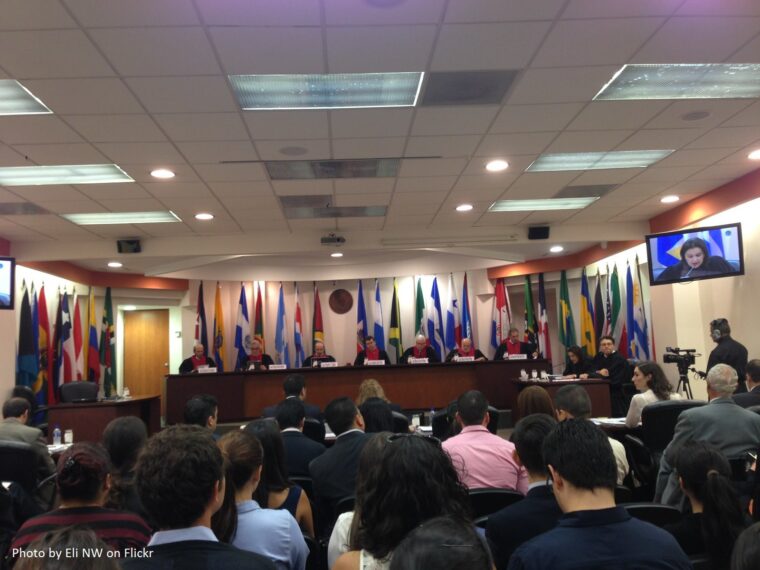
Picture of the Inter-American Court of Human Rights.
The American Declaration of the Rights and Duties of Man and Inter-American Convention on Human Rights
In 1948, the Bogotá Charter was adopted, regulating the functions of the OAS. As a complement to the Charter, the American Declaration was drafted the same year, listing human rights and duties in article form. To further strengthen the status of human rights and the protection of individuals within the regional system, the Inter-American Convention was adopted in 1969. The Convention is legally binding for those states that have signed and ratified it.
Through evolving practice, the American Declaration has developed from “soft law” into an instrument with customary international law status and may today therefore be regarded as legally binding.
The Inter-American Commission on Human Rights
The Commission was established in 1959. It consists of seven members and is based in Washington, D.C., United States. Its purpose is to promote and protect human rights. The Commission primarily monitors and reports on member states’ compliance with human rights obligations and issues recommendations on measures states should take to strengthen protection. It also analyses individual petitions and refers cases to the Inter-American Court where appropriate.
The Inter-American Court of Human Rights
The Inter-American Court was established in 1979 in San José, Costa Rica. It consists of seven judges whose task is to adjudicate cases on the basis of regional human rights instruments such as the American Declaration and the Inter-American Convention.
The Court’s judgments are binding on the state party concerned. The Inter-American Court has the authority to order both legal redress, such as legislative reform, and psychological or moral redress in the form of symbolic reparations.
Did you know?
- The Inter-American Court is unique among regional human rights systems in its ability to order symbolic reparations as a form of redress.
- The OAS is the oldest regional organisation in the world, with roots dating back to the late nineteenth century.
Read our publication “The Contributions of Human Rights Protection to Peacebuilding and Conflict Prevention” (2022) on the Inter-American human rights system, available in english and spanishA summarising policy brief of the report is also available in english and spanish.