Sweden
The Colombian Truth Commission and the diaspora
As a result of the 2016 peace agreement in Colombia between the government and the FARC guerrilla, a truth commission was established to investigate human rights violations committed by the parties during the many years of conflict. The Colombian Truth Commission has taken the important and unique initiative of including Colombians in exile around the world in the search for truth. The Swedish Foundation for Human Rights supports the work of the Colombian Truth Commission in Sweden by facilitating the participation of the Colombian diaspora in the Commission’s work, for example through testimonies, hearings, meetings and cultural events.
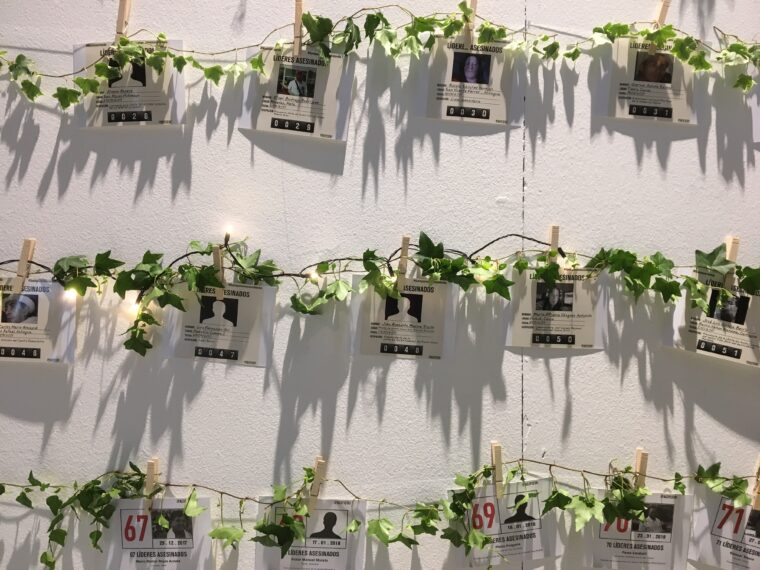
Exhibition at the 2018 Forum for Human Rights (MR-Dagarna) to honor and remember people who were killed in the Colombian armed conflict.
It is a global challenge to involve diaspora groups in peace- and democracy-building processes, while Sweden is home to a rich diversity of diaspora communities. We aim to focus on the role of the diaspora in peace, democracy and human rights, as diaspora groups have often been overlooked or excluded as a factor in these contexts, despite research showing that their participation is crucial to achieving sustainable peace, justice and democracy in their countries of origin. This needs to be highlighted in Sweden as well, in order to affirm to the many diaspora and exile communities that they are rights-holders both in their new country and in their countries of origin. In the longer term, the Swedish Foundation for Human Rights seeks to apply the lessons learned from the process involving the Colombian diaspora to other diaspora groups in Sweden.
For more information about the activities, or if you are a Colombian in exile living in Sweden and would like to take part in the activities, please contact us via:
E-mail: comisiondelaverdad@humanrights.se
Phone:
Facebook: https://www.facebook.com/CEVColombiaNodoSuecia/
How can women's rights be protected during a conflict?
The Swedish Foundation for Human Rights has long worked against impunity and for redress in conflict and post-conflict situations. Women’s needs and rights are often overlooked in these contexts. We have therefore produced an information brochure on how women’s rights can be ensured in efforts to provide reparations after a conflict.
Women’s experiences of vulnerability often differ from those of men during armed conflicts. In addition to the direct consequences of armed conflict—such as killings, torture and rape—women are also subjected to other forms of violence. For example, men’s violence against women in the home tends to increase during armed conflict. Women may also become internally displaced, be forcibly displaced, or lose family members to a greater extent than men. The brochure is based on the four pillars of transitional justice: truth-seeking, access to justice, reparations/compensation, and guarantees of non-recurrence.
Roma rights and redress for human rights violations
In Sweden, Roma people are still subjected to extensive discrimination. Belonging to Roma communities today can mean facing great difficulty in finding employment, having poorer access to healthcare, living in substandard housing, or having no housing at all. This is the result of several hundred years of exclusion.
The Swedish Foundation for Human Rights identified a need to place human rights at the center of the debate on redress for violations of Roma rights in Sweden. While some measures have been taken to address discrimination and abuses, much remains to be done. Reparations and redress are often neglected. The Foundation therefore turned to transitional justice in order to use the methods encompassed by the concept to examine how the Swedish state has worked to provide genuine redress to Roma people in Sweden.
The purpose of the review is to contribute to the debate on redress for the human rights violations endured by Roma people in Sweden and to provide recommendations for the way forward. Inspiration has been drawn from international experiences of truth commissions, judicial proceedings, damages and financial compensation, official apologies, memorials and institutional reforms.
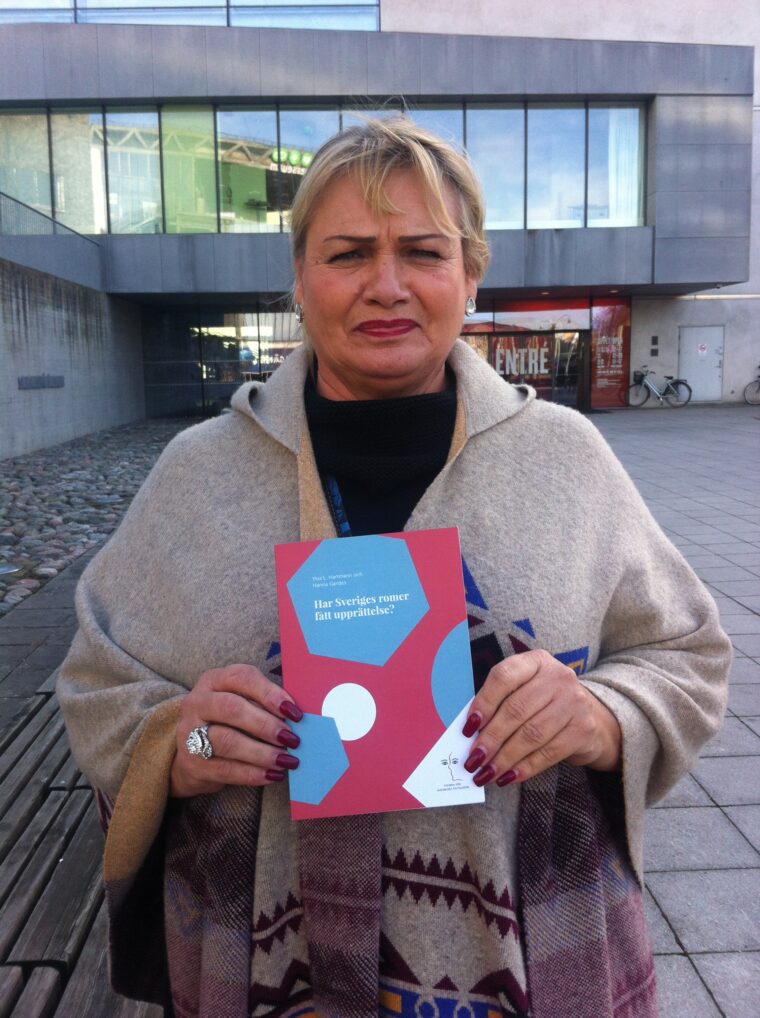
Picture of Soraya Post, Member of the European Parliament, with the Swedish Foundation for Human Rights’ publication “Have Sweden’s Roma Received Redress?” (2015).
Swedish Network for Transitional Justice
In 2015, the Swedish Foundation for Human Rights initiated a Swedish network for transitional justice, which we also coordinate. The purpose of the network is to provide a platform for representatives of civil society organisations and researchers working in the fields of peace, security, development and human rights to exchange experiences and knowledge on transitional justice. The network serves as a natural point of contact for actors and decision-makers interested in transitional justice and increases awareness of the concept in Sweden.
The network is loosely structured. The Swedish Foundation for Human Rights convenes meetings twice a year with support from ILAC:
Network Members:
Organisations
- Amnesty Sverige
- Civil Rights Defenders
- Diakonia
- Fonden för mänskliga rättigheter
- Forum Syd
- Försvarshögskolan, Folkrättscentrum
- International Legal Assistance Consortium, ILAC
- Independent Movement – Sudan
- Kristna Fredsrörelsen
- Kvinna till kvinna
- Life and Peace Institute
- Operation 1325
- Plan Sverige
- Svenska FN-förbundet
Academics
- Kjell-Åke Nordquist, Associate Professor in Peace and Conflict Research, Stockholm School of Theology.
- Dr. Olle Mårsäter, Senior Lecturer in International Law, Director of studies undergraduate and graduate programmes, Faculty of Law, University of Uppsala.
- Dr. Maria Ericson, Lund University, postdoctoral researcher on transitional justice in South Africa and in relation to Roma in Sweden.
- Sally Longworth, Lecturer in International Law at the Swedish Defence University.
- Dr. Pål Wrange, LLM, LLD, Professor of International Law, Vice-Dean, Faculty of Law, Director, Stockholm Center for International Law and Justice.
In May 2015, a number of network members sent a letter announcing the establishment of the network to the UN Special Rapporteur on truth, justice, reparation and guarantees of non-recurrence, Pablo De Greiff. Read the letter here.
If your organisation is interested in joining the network, please contact us at info@humanrights.se