The African human rights system
he African human rights system consists primarily of three pillars – the African Commission on Human and Peoples’ Rights (the Commission), the African Charter on Human and Peoples’ Rights (the African Charter), and the African Court on Human and Peoples’ Rights (the Court). All of these bodies operate under the intergovernmental organisation the African Union (AU), which replaced the Organisation of African Unity in 2001.
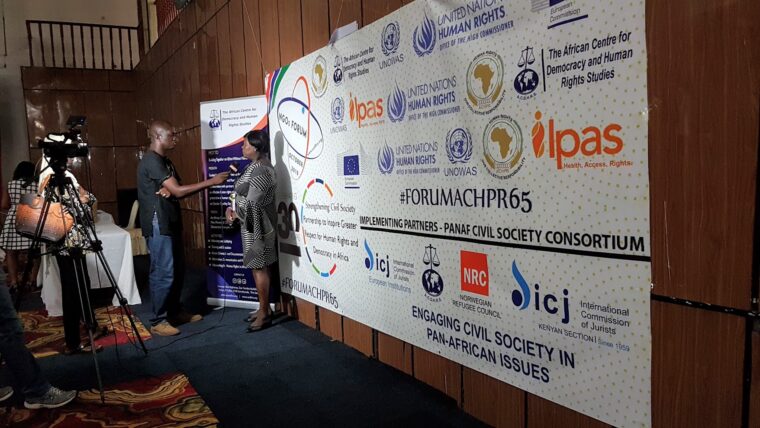
Picture from an interview at the 65th NGO Forum of the African Commission’s autumn session, 2019.
The African Commission on Human and Peoples’ Rights
The Commission was established in 1987 in Addis Ababa, Ethiopia. Its primary mandate is to protect and promote human and peoples’ rights, interpret the provisions of the African Charter, and determine the admissibility of cases brought before the African Court on Human and Peoples’ Rights.
The African Charter on Human and Peoples’ Rights
The African Charter was adopted in 1981 with the aim of counteracting hatred, conflict and war between different peoples and cultures within Africa. It entered into force in 1986. Fifty-three of the African Union’s fifty-four member states have signed and ratified the African Charter. This means that all AU member states, except South Sudan, have approved and incorporated the Charter into their national legal frameworks and thereby committed themselves to its provisions.
The African Court on Human and Peoples’ Rights
The African Court is seated in Arusha, Tanzania. It was established in 1998 and entered into force in 2004. The Court consists of eleven judges whose task is to provide advisory opinions to states parties and to adjudicate cases relating to the African Charter or other regional human rights conventions. The Court’s judgments are legally binding.
The Court has the mandate to consider complaints from both individuals and non-governmental organisations. As mentioned above, the Commission is responsible for referring cases to the Court. However, it is also possible to submit a complaint directly to the Court if the state concerned has made a declaration accepting such direct access.
Did you know?
- The African Charter is the only regional human rights convention in the world that includes civil and political rights as well as economic, social and cultural rights within a single legally binding instrument.
- The African Charter is unique in explicitly recognising both individual and collective rights.
Read our publication on the African human rights system, “Silencing the Guns in Africa” (2020), here, and a summarising policy brief here och en sammanfattande policy brief here.