Sweden
What does the Swedish Foundation for Human Rights do in the field of economic, social and cultural rights?
The Swedish Foundation for Human Rights highlights the importance of economic, social and cultural rights and the indivisibility of human rights in various contexts. The outcomes of the Foundation’s work on ESC rights mainly consist of information dissemination and advocacy efforts. The Swedish Foundation for Human Rights coordinates civil society’s recurring parallel report to the Committee on Economic, Social and Cultural Rights. On 21–22 February 2024, the Committee held an interactive dialogue with the Swedish Government on its seventh report to the Committee. The reporting process increases awareness of these rights and of the shortcomings that still exist in Sweden.
Read more:
- The Conventions can be found in english and in swedish.
- Civil society’s joint report to the Committee on Economic, Social and Cultural Rights (2024)
- Institutet för mänskliga rättigheters rapport till ESK-kommittén (2024)
- Sametingets rapport till ESK-kommittén (2024)
- Regeringens sjunde rapport (2021)
- Sakråd om uppföljningen av rekommendationer till Sveriges genomförande av konventionen för ekonomiska, sociala och kulturella rättigheter
- ESK-kommitténs rekommendationer till svenska regeringen (2024)
- Hos FN:s kommitté om ekonomiska, sociala och kulturella rättigheter (CESCR) kan du läsa mer om ESK-rättigheter.
- Debattartikel “Mänskliga rättigheter går inte att damma av vid behov – för att sedan glömmas bort igen” på Altinget.se (12 april 2024)
Parallel reporting
About parallel reporting
A state that has acceded to (ratified) a UN convention (a State party) is obliged to report regularly to the expert committee that monitors compliance with the convention, for example the UN Committee on Economic, Social and Cultural Rights. In the case of the so-called Universal Periodic Review (UPR), it is the UN Human Rights Council that receives the report, and other member states that review compliance with human rights obligations. This takes place approximately every five to ten years. The committee/council also receives reports from civil society, from independent national institutions (in Sweden’s case, the Institute for Human Rights), and from self-governing Indigenous bodies (in Sweden’s case, the Sami Parliament). Reports submitted by civil society are referred to as parallel reports, alternative reports, or shadow reports. Civil society reports present the perspective of rights-holders on the implementation of the rights set out in the convention. It is natural that the accounts provided by duty-bearers (the state) and rights-holders (civil society) differ. Taken together, the various reports give the committee a fairly comprehensive picture of the human rights situation in the country.
To facilitate the review process, it is valuable for civil society to coordinate and submit a joint report. One example is the Swedish Foundation for Human Rights’ coordination of the report to the Committee on Economic, Social and Cultural Rights.
The next step in the reporting cycle is the so-called interactive dialogue (or “hearing”) that the committee/council holds with the government concerned on site in Geneva. The dialogue is based on the information submitted through the various reports. It eventually results in conclusions and recommendations to the state on how to improve the implementation of the convention. It is clear from the recommendations issued that parallel reporting plays a significant role.
Civil society’s joint report to the Committee on Economic, Social and Cultural Rights
The Swedish Foundation for Human Rights coordinates Swedish civil society’s alternative report to the Committee on Economic, Social and Cultural Rights in connection with the Swedish state’s periodic reporting, which takes place every four or five years. In January 2024, the Swedish Foundation for Human Rights submitted civil society’s joint report to the Committee on Economic, Social and Cultural Rights ahead of its review of Sweden in February 2024.
In 2019, the Swedish Foundation for Human Rights produced a mid-term report, focusing on racism and related forms of intolerance.The ambition is for mid-term reporting to be carried out on a regular basis as a way of further strengthening and systematising Sweden’s human rights work in accordance with the conventions. If your organisation is interested in taking part in the work on the next report, or would like to receive updates on the field of economic, social and cultural rights, please contact us at info@humanrights.se.
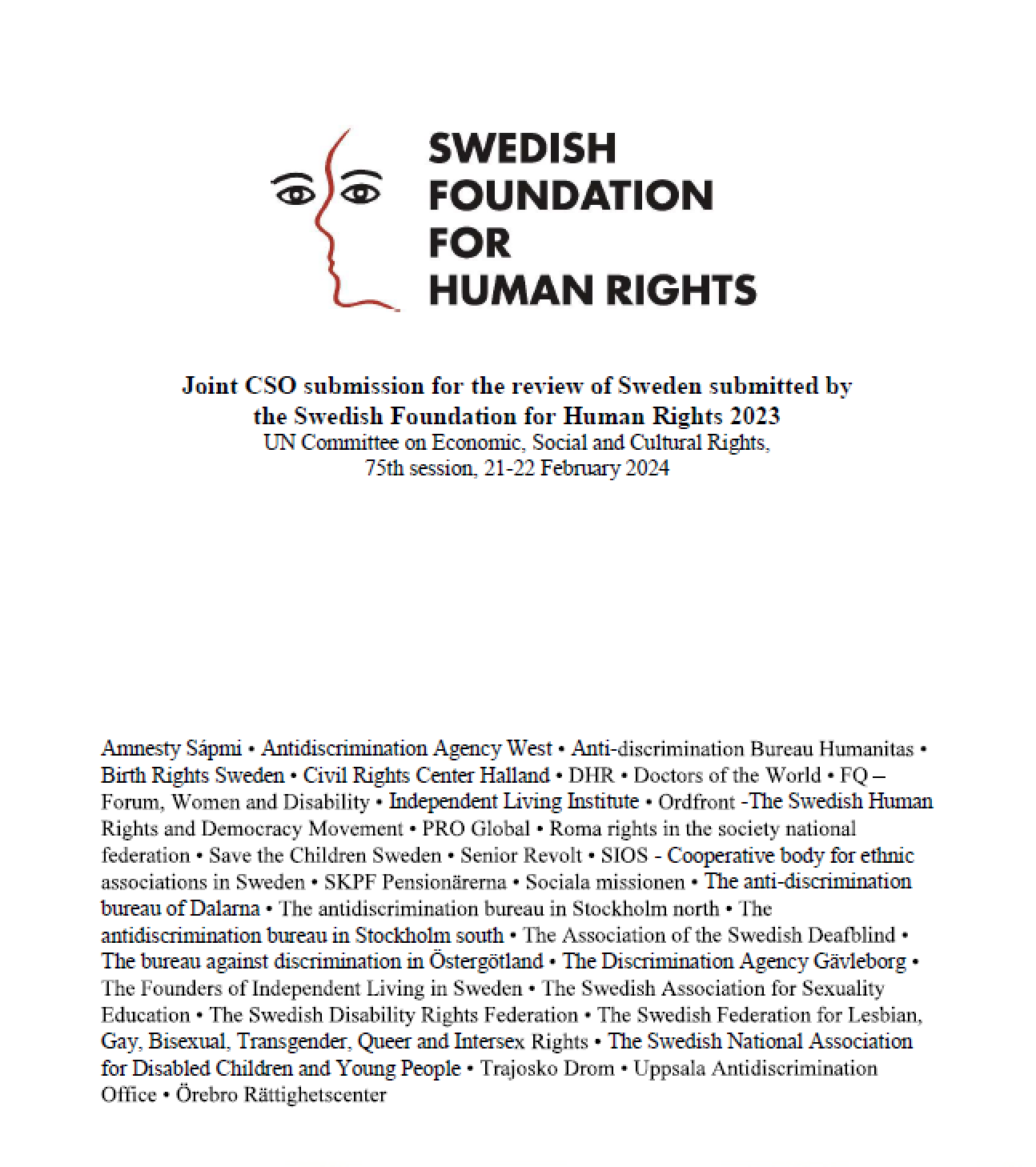
Audio description: Joint CSO submission for the review of Sweden submitted by the Swedish Foundation for Human Rights 2023, UN Committee on Economic, Social and Cultural Rights, 75th session, 21-22 February 2024. Below are the 33 signatory organisations.
Civil society’s joint report to the UN Human Rights Council
In 2024, the Swedish Foundation for Human Rights coordinated civil society’s report to the UN Human Rights Council, a review process also known as the Universal Periodic Review (UPR).
The Universal Periodic Review (UPR) is a review in which countries assess each other’s human rights commitments and progress. Our joint parallel report is submitted together with several individual reports and supplementary information from the Institute for Human Rights. The UN Human Rights Office (OHCHR) compiles these documents as the basis for the review, together with the Swedish Government’s own report.
In September 2024, the Swedish Foundation for Human Rights submitted the joint report to the Human Rights Council ahead of the review that took place in May 2025 in Geneva. Fourteen Swedish civil society organizations contributed to the report, and an additional six expressed their support for it.
Current Projects
Nothing about us without us!
Together with HandikappHistoriska Föreningen HHF), the Swedish Foundation for Human Rights implemented during 2021–2023, with support from Allmänna Arvsfondena project called Nothing about us without us!
The aim of the project was to capture and disseminate experiences from Swedish participation in the process leading to the development of the Convention on the Rights of Persons with Disabilities (CRPD). Never before had civil society been so actively involved in the drafting of a UN convention, nor played such a clear role in its implementation and monitoring. In addition, the CRPD represents a milestone in the history of human rights conventions, as it reunites economic, social and cultural rights with civil and political rights within a single convention.
Audio description: the project logo (a light blue light bulb with a clenched fist as the filament, along with the text “Nothing about us without us”) against a black background.
On the project’s website: ingetutanoss.se you can read more about the project, and download or order the book in various formats.