Colombia
The Swedish Foundation for Human Rights supports redress for victims of conflict in Colombia.
Since the 1940s, thousands of people have been affected by the conflict in the country. In 2016, the Colombian government entered into a peace agreement with the guerrilla group FARC. This was followed by a transitional justice process aimed at providing redress for the human rights violations committed during the conflict. However, new armed actors have emerged since the peace agreement, and several armed conflicts are currently ongoing. In this political context, the Colombian population is more vulnerable to human rights violations by both state and non-state actors, particularly already marginalised groups such as women, Indigenous peoples and Afro-Colombians. Consequently, the work of Colombian civil society organisations to protect and promote human rights is of great importance. In addition, these organisations serve as an important link to intergovernmental organisations such as the UN and the OAS, which are also key components of human rights efforts in the country.
Integrated redress for victims of conflict requires capacity among rights-holders, the organisations that provide legal support for these processes, as well as the authorities that are responsible for guaranteeing victims’ rights. The Swedish Foundation for Human Rights collaborates with José Alvear Restrepo Lawyers’ Collective (CAJAR), Movement of Victims of State Crimes (MOVICE) and Akubadaura Indigenous Lawyers’ CollectiveThis project is financed with Forum CIV:s Swedish Partnership Programme (LPF-programme)
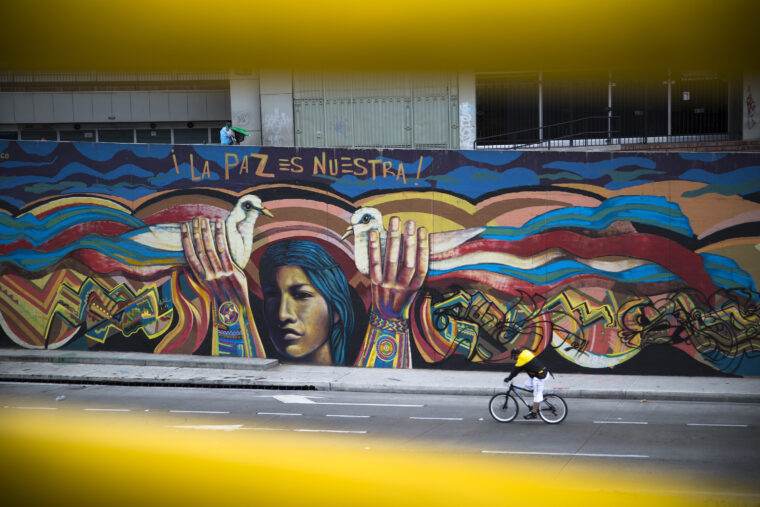
Graffiti for peace in Bogotá. Photo: Bianca Bauer.
José Alvear Restrepo (Lawyers’ Collective (CAJAR))
CAJAR was founded 45 years ago. CAJAR has its roots in the organisation Asociación Nacional de Profesionales (ASONALPRO), which brought together experts from various fields who worked to strengthen the protection of political prisoners and individuals persecuted for their political views, as well as to assist victims and their families in cases of human rights violations such as arbitrary detention, enforced disappearances, extrajudicial executions, massacres and torture. In 1980, CAJAR was officially registered and became one of the first organisations composed of lawyers to work for the defense of human rights in Colombia, particularly the protection of civil and political rights.
In 1995, the collective began its work to promote and protect economic, social and cultural rights (ESCR). In connection with this, a process was launched to train new lawyers through the establishment of a fellowship programme for legal assistants.
Since 1999, CAJAR has developed its international work by restructuring its engagement with intergovernmental monitoring bodies such as the United Nations, the Organisation of American States (OAS), and the International Labour Organisation (ILO). In November 2000, CAJAR was granted consultative status with the OAS. A process to obtain consultative status with the United Nations is also currently underway. CAJAR litigates cases at both the national and international levels, including before the Inter-American Court of Human Rights (IACHR).
Today, the José Alvear Restrepo Lawyers’ Collective (CAJAR) has a team of 27 employed lawyers and human rights experts. The organisation primarily works in three areas: combating impunity; territorial justice and the fight against climate change; and conflict resolution and peacebuilding. CAJAR’s mission is to defend and promote human rights from a comprehensive perspective, grounded in the indivisibility of rights and their interdependence.
– The aim of our work is to develop and implement proposals for the effective and just realisation of human rights within the framework of national and international law.These efforts aim to help ensure peaceful coexistence, pluralism, diversity and democracy in a state where themost vulnerable groups – women, Indigenous people and Afro-Colombians are included and have their rights fulfilled. MaríadelPilar Silva Garay Board Member and, Project Manager at CAJAR
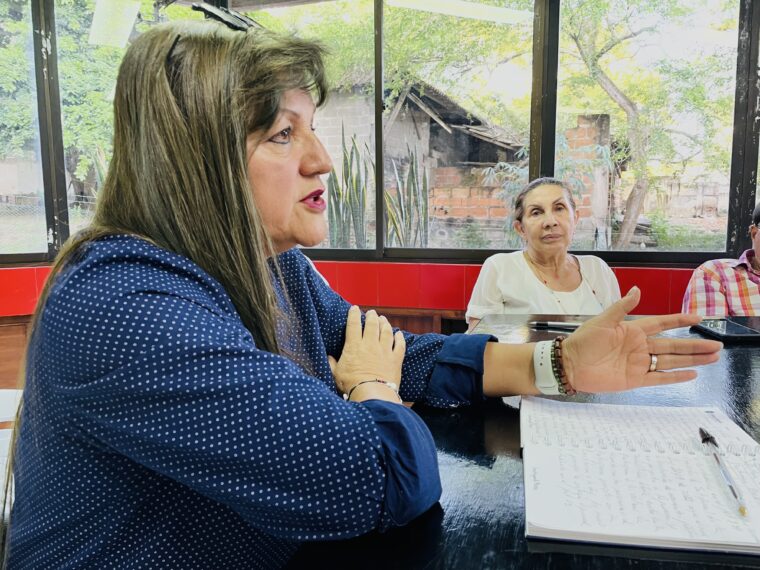
Maria del Pilar Silva during an advocacy meeting. Photo: Swedish Foundation for Human Rights
Movement of Victims of State Crimes (MOVICE)
Movement of Victims of State Crimes (MOVICE) was founded in 2005 in response to the armed conflict—particularly political violence and the high levels of impunity for crimes committed by state and paramilitary actors in Colombia. The movement seeks to shed light on the situation and to strengthen victims’ ability to bring attention to their circumstances and to claim their rights to truth, justice, full reparation, and guarantees of non-recurrence of human rights violations. For MOVICE, respect for these rights and reduced impunity are necessary conditions for the emergence of lasting peace and genuine democracy.
(MOVICE) consists of more than 300 organisations representing victims of various crimes committed in connection with the conflict, including victims of forced displacement, massacres and political genocide. In addition to a central coordinating body, MOVICE comprises more than 22 regional groups that carry out activities throughout Colombia.
In addition to advocating for the implementation of international legislation on victims’ rights, MOVICE works, among other things, to document cases in the “Nunca Más” database, and its advocacy efforts contribute to incorporating victims’ perspectives into public debate. MOVICE has submitted reports to the Truth Commission and facilitates cooperation and dialogue between victims and officials from the Unit for the Search for Persons Deemed Missing and the peace tribunals, which are mechanisms within the transitional justice system. A noteworthy component of its work is the creation of memory galleries, as well as the use of holistic methods aimed at addressing the psychosocial aspects of redress for victims of conflict.
CAJAR and MOVICE aim, during 2024, to help strengthen victims’ voices and their demands for justice in the peace process between the Colombian government and the ELN.
– During the implementation of the project, I have had the opportunity to continue strategic actions that contribute to advocacy at every level of the integrated system for truth, justice, reparation and guarantees of non-recurrence, including the participation of Movement of Victims of State Crimes (MOVICE) as the organisation that submitted the broadest request for precautionary measures within the framework of the special jurisdiction for peace to protect sites where we suspect that disappeared persons may be located. The project has strengthened cooperation with victims and with the unit for the search for persons deemed missing in Colombia. — Valentina Avila, lawyer and project manager at MOVICE
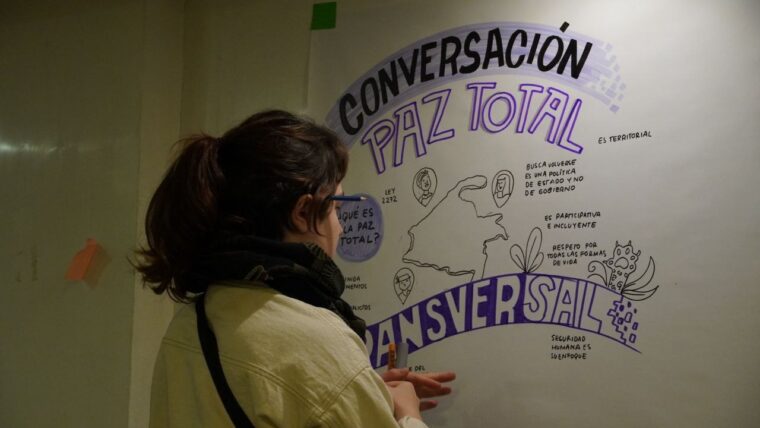
Annual meeting of the schools for historical memory 2023. Photo: MOVICE
Akubadaura Indigenous Lawyers’ Collective
Akubadaura, founded in 2012, is a non-profit organisation. The name comes from the Emberá Chamí language and means “helper.” It reflects the organisation’s mission and commitment to assist and support Indigenous peoples in a range of legal matters, from land restitution to the application for and issuance of protective measures. The aim of the work is to support and strengthen the capacity of Indigenous communities to participate and find solutions to the complex challenges they face, with a particular focus on the implementation of free, prior and informed consent and equality.
Akubadaura also reviews and disseminates information and research to the public, organisations and authorities. This support serves as an important basis for decisions concerning land areas, climate change, environmental and economic justice, as well as collective redress for Indigenous communities affected by the conflict. In addition, Akubadaura creates processes for collaboration with other organisations and connects actors with the clear aim of contributing to policies that promote peace and territorial reconciliation.
– For Akubadaura, every step toward living together is a collective effort; cooperation is essential. We are guided by a territorial, gender-responsive and participatory approach, and our goal is to strengthen the leadership of authorities, women leaders and young people. Lina Marcela Tobón Yagarí, Executive Director for Akubadaura.
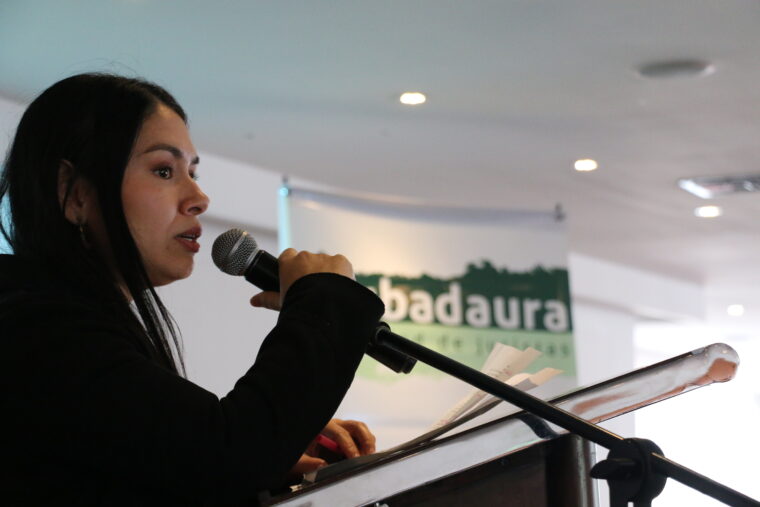
Lina Marcela Tobón Yagarí. Photo : Akubadaura
Why is the Colombia programme relevant?
The cooperation between the Swedish Foundation for Human Rights and Colombian partners enables their presence in conflict-affected areas and increases support for vulnerable groups in society, such as women, Afro-Colombians, Indigenous peoples and small-scale farmers. The programme supports, among other things, five Indigenous communities of the Wiwa and Emberá peoples in Sierra Nevada de Santa Marta, Guajira and northern Choco.
The cooperation with Colombian partners is considered to have a very positive impact, as it has led to a significant strengthening of groups affected by human rights violations. Through legal and psychosocial approaches, rights-holders have been able to raise their voices to denounce and shed light on, among other things, the state’s repressive policies and the impunity prevailing in victims’ cases.
–This strengthening has led to a considerable increase in victims’ capacity to bring their cases before national authorities, enabling them to demand that information regarding their cases be investigated and that those responsible be prosecuted. It should be emphasised that this capacity is not limited to the legal sphere, but is also exercised through activism. María del Pilar Silva Garay
A peaceful and just development in Colombia also depends on the attitudes, capacity and knowledge of authorities and power-holders to ensure victims’ rights.The programme therefore supports partners’ advocacy and information efforts directed at decision-makers, public officials and other human rights organisations.
- Watch the video about CAJAR’s work to support the Wiwa Indigenous peoples in northern Colombia: